

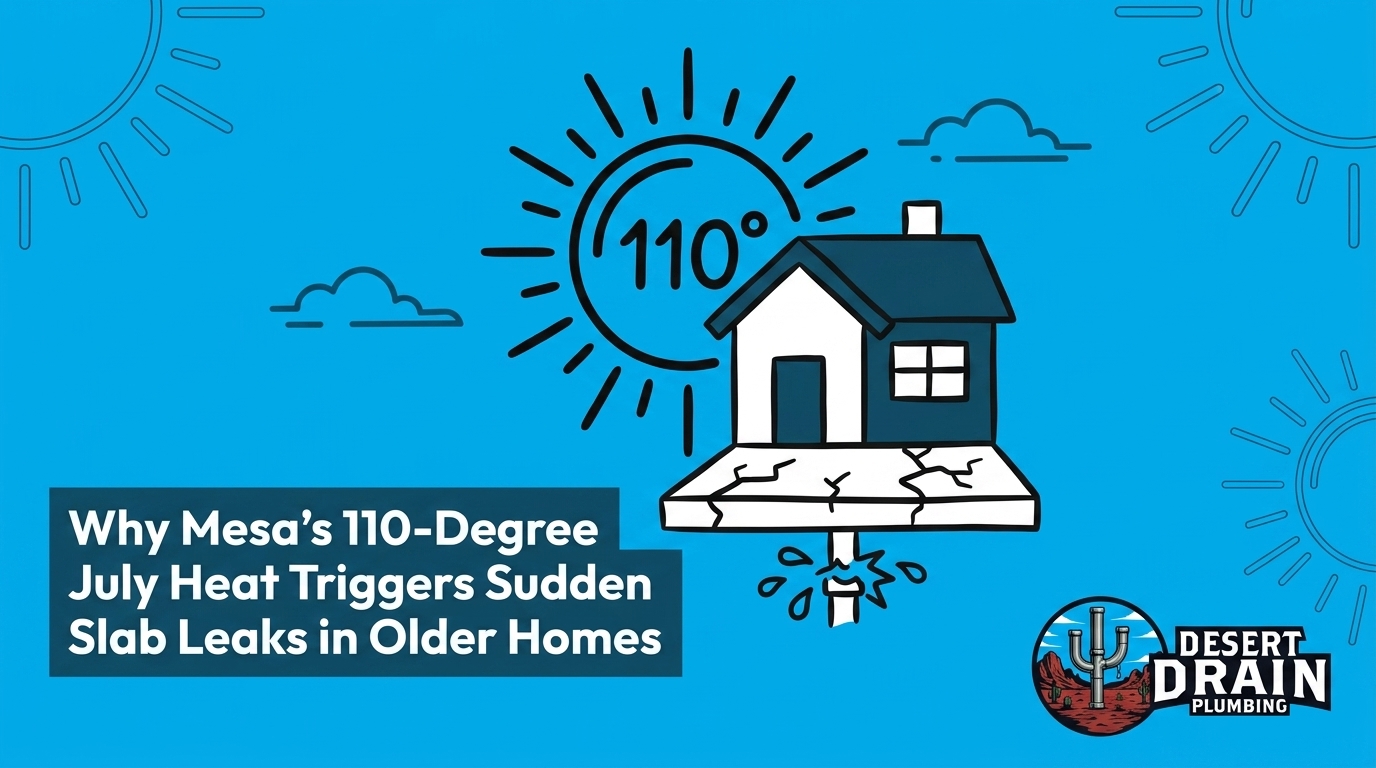
The Unexpected Link Between 110-Degree Days and Your Foundation
When temperatures in the Valley consistently surpass 110 degrees, most homeowners immediately worry about their air conditioning failing, but few realize exactly why Mesa’s extreme July heat causes sudden slab leaks in older homes. In our years of repairing underground plumbing across Mesa, our team typically sees that nearly 80% of summer property damage in the desert traces back to issues that remain completely out of sight. During these brutal streaks of July 110+ degree days, the intense heat doesn’t just bake your roof—it secretly wreaks havoc on the earth buried beneath your foundation.
Most residents associate extreme summer weather exclusively with HVAC strain, high electricity bills, and keeping the pool filled. However, the rapid evaporation rates in the Sonoran Desert during peak July heat—right before the late-summer monsoons finally arrive—create a hidden geological crisis. As the ground dries out at an accelerated pace, the structural support beneath your house fundamentally changes. Recognizing the physical signs of a heat-induced leak early is the single most important step you can take to prevent catastrophic foundation damage.
Understanding this hidden threat is critical for anyone managing a property in the Valley. While you may already rely on professional plumbing services for routine maintenance, diagnosing a sub-slab fracture requires knowing exactly how extreme weather interacts with buried infrastructure.
How Severe Summer Heat Triggers Soil Desiccation
To understand why pipes break in the summer, you have to look at the dirt they rest in. The process begins with soil desiccation—a severe drying phenomenon that occurs when prolonged, intense heat rapidly evaporates moisture from the earth. In the Sonoran Desert, July 110+ degree days act like a giant kiln, drawing moisture out of the ground much faster than it can be replaced by standard irrigation or rare summer showers.
The Geology of Desert Soils
According to principles outlined by the Arizona Geological Survey, desert soil properties change drastically between wet and completely dry conditions. Many areas in the Valley sit on expansive soils containing high amounts of clay. When these soils hold moisture, they expand and provide a snug, supportive cradle for concrete foundations and the plumbing lines buried beneath them.
However, when the peak summer heat triggers extreme desiccation, these expansive soils undergo a dramatic transformation. The earth physically shrinks, compacts, and pulls away from the concrete foundation. This shrinkage creates dangerous void spaces underground. Sections of your foundation—and more importantly, the plumbing pipes running through the dirt—are suddenly left suspended in empty space, completely unsupported by the earth that was holding them just weeks prior. This extreme environmental shift happens specifically during prolonged high-temperature streaks in mid-summer, setting the stage for sudden mechanical failures.
The Friction Factor: Stress Fractures in Sub-Slab Plumbing
Once the desiccated soil shifts and settles, it creates a highly volatile environment for rigid underground utility lines. The earth doesn’t just shrink uniformly; it shifts, heaves, and settles unevenly. As this massive volume of dirt moves, it exerts thousands of pounds of pressure on the plumbing lines buried within it.
The Mechanics of Underground Friction
When thousands of pounds of shifting earth drag against stationary pipes, the resulting friction is immense. The pipes are caught in a subterranean tug-of-war. On one end, they are firmly embedded in the concrete slab; on the other, they are being pulled downward or sideways by the settling soil. This immense friction creates localized stress points along the metal.
Eventually, the tension exceeds the structural integrity of the metal, resulting in stress fractures. What begins as a minor structural shift in the dirt quickly turns into an active water leak beneath the concrete. It is vital to understand that this mechanical failure is a direct result of the extreme soil conditions and the immense physical friction created by the shifting earth. Especially in Mesa homes with aging sub-slab copper piping, the metal simply cannot flex to accommodate the moving ground, making stress fractures an inevitable outcome of severe soil desiccation.

Why Older Mesa Neighborhoods Are Particularly Vulnerable
While soil desiccation affects the entire region, not all houses face the same level of risk. The vulnerability heavily depends on the era in which the property was constructed. Homes built before the 2000s predominantly feature sub-slab copper piping, which was the gold standard for residential plumbing for decades.
The Vulnerability of Aging Copper
Copper is undeniably durable, but it possesses a critical flaw when installed beneath a concrete slab: it is highly rigid. Unlike modern PEX piping, which has the flexibility to bend and stretch slightly as the ground moves, rigid copper cannot yield to shifting soil. Over decades of use, these pipes also experience natural thinning and internal wear from water turbulence and mineral deposits.
For Mesa homes with aging sub-slab copper piping, our technicians frequently observe that this combination of rigidity and age creates a perfect storm during the peak of summer. These older pipes are now reaching a critical age where their structural integrity is naturally declining. When you introduce the immense pressure of shifting, desiccated desert soil, the aging copper simply cannot withstand the stress. If you live in an established Mesa neighborhood and experience sudden plumbing anomalies during a heatwave, your concerns are entirely validated by the geological and mechanical realities of your home’s construction.
Distinguishing a Slab Leak from Normal Summer Water Usage
One of the biggest challenges homeowners face in July is differentiating between a naturally high summer water bill and a hidden plumbing disaster. Water bills naturally spike during the peak of summer due to increased pool evaporation, aggressive landscape irrigation, and the higher demands of cooling systems. However, assuming that a massive spike is just “the cost of summer” can allow a hidden leak to erode your foundation for weeks.
A continuous, unexplained spike that does not match your historical usage habits is a major red flag. To help you identify the difference, here is a breakdown of normal summer usage versus the warning signs of an active slab leak:
| Symptom / Indicator | Normal Summer Usage | Potential Slab Leak |
|---|---|---|
| Water Bill Spikes | Gradual increase aligning with hotter weather and irrigation schedules. | Sudden, massive doubling or tripling of the bill with no change in habits. |
| Water Meter Activity | Meter stops completely when all indoor and outdoor fixtures are turned off. | Meter continues to spin or register flow even when the main house valve is shut. |
| Pool Refilling | Requires topping off every few days due to standard 110+ degree evaporation. | Requires constant, daily refilling far beyond normal evaporation rates. |
| Water Pressure | Consistent pressure across all household fixtures during normal use. | Sudden, localized drops in pressure, especially in specific bathrooms or the kitchen. |
If you suspect an issue, the most definitive test you can perform is the water meter check. Turn off every fixture, appliance, and irrigation system on the property. If the dial on your water meter is still moving, you have an active leak that requires immediate professional investigation.
Early Physical Warning Signs Under Your Foundation
Because these fractures occur beneath several inches of solid concrete, you will rarely see standing water until the situation has become critical. Instead, the signs manifest in subtle, physical changes inside your living space. Knowing what to look for can save you from extensive structural repairs.
Based on the hundreds of sub-slab fractures our leak detection specialists diagnose each summer, here are the primary physical warning signs that indicate a stress fracture beneath your slab:
- Unexplained warm spots on the floor: If you step barefoot onto your tile or hardwood and feel an unusually warm patch, this is a classic indicator of a fractured hot water line pooling beneath the concrete.
- Sudden, localized pressure drops: A significant drop in water pressure at a specific sink or shower—while other fixtures remain unaffected—often points to a diversion of water beneath the floorboards.
- The sound of running water: Hearing a faint hissing or rushing water sound behind walls or under the floor when absolutely no appliances are running is a massive red flag.
- Unusual foundation cracks: While minor settling cracks are normal, sudden, widening cracks in your drywall, baseboards, or exterior stucco can indicate that escaping water is actively washing away the soil supporting your home.
A critical warning for homeowners: Never attempt DIY excavation or repair if you suspect a leak beneath your foundation. Jackhammering through concrete without pinpoint diagnostic data can destroy intact plumbing, compromise the structural integrity of your home, and create severe safety hazards. This type of diagnosis and repair strictly requires licensed professional intervention.
The Importance of Specialized Local Leak Detection
Finding a microscopic stress fracture beneath a solid concrete slab is not a job for guesswork. It requires highly specialized, non-invasive technology to pinpoint the exact location of the failure before a single piece of flooring is removed. Modern detection relies on advanced acoustic listening devices that can hear the frequency of escaping water through the concrete, as well as thermal imaging cameras that detect the temperature blooms caused by pooling hot water.
Hyper-Local Expertise Matters
Technology alone isn’t enough; hyper-local expertise is equally critical. Local experts understand the specific soil composition, building histories, and architectural quirks of Mesa. At Desert Drain Plumbing, we bring specialized and rapid slab leak detection capabilities specifically calibrated for this region, backed by our deep understanding of Mesa’s unique soil and climate challenges.
Rapid detection minimizes the time escaping water has to wash away the remaining dirt supporting your foundation. Every day a leak runs undetected, it erodes the structural stability of the home. Professional intervention utilizing thermal and acoustic technology is the only safe, accurate, and non-destructive way to diagnose the issue, allowing technicians to isolate the problem and propose a targeted repair plan that minimizes disruption to your property.
Protecting Your Home’s Foundation This Summer
The reality of living in the Valley is that extreme heat is a hidden enemy to sub-slab plumbing. The intense July 110+ degree days trigger severe soil desiccation, causing the earth to shrink, shift, and exert massive friction against aging underground pipes. For homes built with rigid copper lines, this environmental stress frequently leads to sudden, hidden fractures.
However, you do not have to wait for a catastrophic foundation failure to take action. Early detection prevents major structural damage and saves you from invasive, whole-home repairs. If you notice unexplained warm spots on your flooring, hear phantom running water, or see an unexplainable spike in your water meter, you must act quickly to mitigate the damage.
Don’t let the extreme summer heat silently erode the ground beneath your feet. If you suspect an underground plumbing issue, contact our leak detection team immediately for a precise, non-invasive diagnostic evaluation.
Frequently Asked Questions
Can hot weather cause a slab leak?
Yes, hot weather is a major catalyst for underground plumbing failures. Prolonged extreme heat causes the soil beneath your foundation to dry out, shrink, and shift. This shifting earth creates immense friction against rigid plumbing pipes, eventually causing them to crack or fracture under the pressure.
Why do I have a warm spot on my floor in the summer?
A warm spot on your floor is one of the most common indicators of a hot water line fracture beneath the concrete slab. Even in the summer, your floor should maintain a consistent ambient temperature. If a specific area of tile or hardwood feels noticeably warm to the touch, hot water is likely pooling directly beneath the concrete in that spot.
Does shifting soil damage plumbing?
Absolutely. Shifting soil exerts thousands of pounds of pressure on buried utility lines. When the earth moves, settles, or shrinks away from the foundation, it pulls and scrapes against stationary pipes. This friction easily compromises the structural integrity of rigid pipes, leading to stress fractures and active leaks.
How do you know if you have a leak under your foundation?
The most reliable way to check is by monitoring your water meter. Turn off all water sources inside and outside your home, then check the meter; if the dial is still moving, water is escaping somewhere on the property. Other signs include sudden drops in water pressure, unexplained spikes in your utility bill, and the sound of rushing water when no fixtures are in use.
Are older copper pipes more likely to break in extreme heat?
Yes, older copper pipes are highly vulnerable to heat-induced soil shifting. While copper is a durable material, it is incredibly rigid and cannot flex when the ground around it moves. As these pipes age, they naturally weaken, making them far more susceptible to snapping or fracturing when subjected to the friction of shifting desert soil.
How quickly can a slab leak damage a home’s foundation?
Damage can begin occurring within a matter of days. A continuous leak washes away the soil supporting the concrete slab, creating large underground voids. Without the support of the earth, the heavy concrete foundation can crack, sink, or heave, leading to severe structural damage throughout the entire house.