

The Hidden Plumbing Threat Beneath Your Floors
You notice a mysterious warm spot on your kitchen floor, or perhaps an inexplicably high water bill, but everything above ground looks perfectly dry—a scenario that makes professional slab leak repair a sudden priority for many homeowners. Beneath the finished flooring of most modern homes lies a massive concrete foundation slab. This thick layer of poured concrete serves as the structural anchor for the building, but it also acts as a heavy, impenetrable shield over a complex network of pressurized plumbing lines. When one of those buried lines begins to fail, the resulting leak is completely hidden from view.
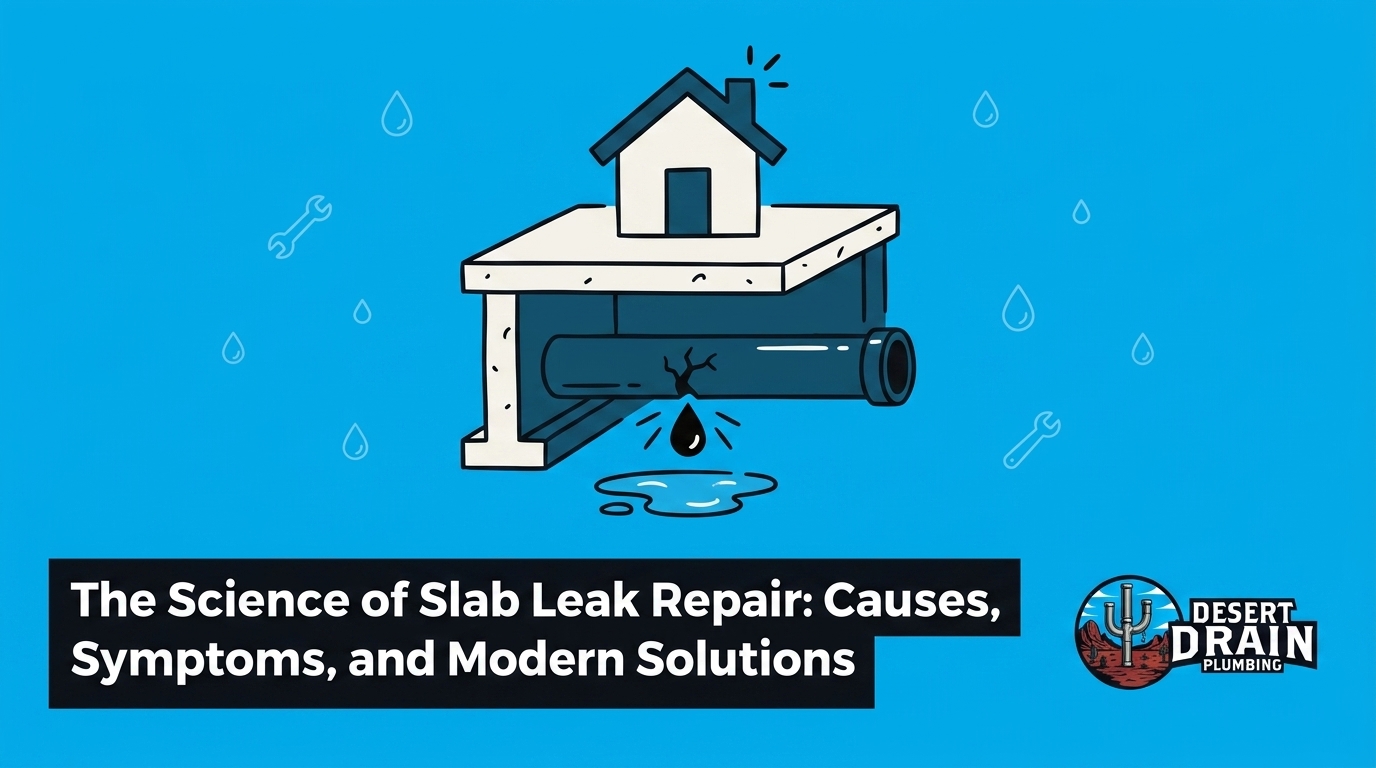
A slab leak is simply a plumbing leak that occurs in the water supply or drainage lines running below or encased directly within this concrete foundation. Because the foundation slab forms a protective barrier, these leaks can flow silently for weeks or months before making themselves known. For homeowners in Mesa AZ, the psychological stress of knowing water is actively leaking under the house—without being able to see exactly where it is or how much damage it is causing—can be overwhelming. At Desert Drain Plumbing, our team has helped countless local families navigate this exact nightmare, turning panic into a clear, actionable repair plan.
Understanding the mechanics of a slab leak is the first step toward resolving it. The plumbing architecture beneath a home is durable, but it is not invincible. By learning how to identify the subtle early warning signs, understand the environmental factors that cause pipes to fail, and explore how modern non-destructive technology locates the source, you can confidently address the issue before it compromises the structural integrity of the home.
What Exactly Constitutes a Slab Leak?
To fully grasp what a slab leak entails, it helps to understand the difference between the two main types of plumbing networks buried beneath the foundation: pressurized supply lines and gravity-fed drainage lines. Pressurized supply lines carry fresh, potable water into the home, splitting into cold and hot water circuits. Drainage lines, which are typically much wider, carry wastewater away from the home using gravity. While leaks can technically occur in either system, we typically see the vast majority of slab leaks happen in pressurized hot water supply lines.
Hot water lines are particularly vulnerable due to the constant cycle of thermal expansion and contraction. As hot water flows through a copper pipe, the metal heats up and expands. When the water stops flowing and cools, the pipe contracts. Over years and decades, this microscopic shifting causes the exterior of the pipe to rub against the abrasive concrete or gravel surrounding it, eventually wearing the metal thin.
When a pipe finally breaches, the escaping water behaves predictably: it seeks the path of least resistance. Even during a July peak summer dry spell, water trapped beneath a concrete slab will eventually find a way out. It might saturate the soil below, creating a muddy void, or it might force its way upward through the porous concrete, eventually reaching the subfloor. It is important to clarify that a slab leak is a symptom of a failing plumbing pipe, not a symptom of a failing foundation. However, if left unchecked, the immense volume of escaping water will rapidly lead to severe foundation issues.
Early Warning Signs You Shouldn’t Ignore
Because the plumbing is completely encased in concrete, you cannot simply look under a sink to verify a slab leak. Instead, you must rely on secondary environmental clues. In our years of performing slab leak repair throughout Mesa, we have found that catching these signs early is the most effective way to minimize subsequent property damage.
- Unexplained water bill spikes: If your household water usage habits have not changed, but your monthly bill suddenly doubles or triples, a hidden leak is highly probable. A continuous pressurized leak can waste thousands of gallons of water in a single billing cycle.
- Warm spots on flooring: Because hot water lines are the most frequent culprits, the escaping hot water will heat the surrounding concrete. This often manifests as a noticeable, persistent warm patch on tile, hardwood, or carpeted floors, especially noticeable when walking barefoot.
- The persistent sound of running water: If you can hear a faint hissing or rushing water sound inside the walls or floors when all faucets, showers, and appliances are completely turned off, water is actively escaping from a pressurized line.
- Damp carpets and warped hard flooring: As moisture pushes upward through the concrete slab, it becomes trapped beneath the flooring. This leads to inexplicably damp carpet padding, buckling hardwood planks, peeling linoleum, or moisture buildup and discoloration along the lower baseboards.
- A sudden drop in household water pressure: When a significant volume of water is escaping beneath the foundation, there is less pressure available to push water out of your showerheads and faucets, resulting in a noticeable drop in overall system pressure.

Why Do Pipes Fail Under Concrete?
Pipes buried under concrete do not fail arbitrarily. Their deterioration is almost always the result of long-term environmental stress, chemical reactions, and physical friction. Understanding these root causes helps clarify why certain regions experience higher rates of underground plumbing failures.
The Problem of Hard Water Corrosion
The mineral content of the municipal water supply plays a massive role in the lifespan of copper plumbing. Water is considered “hard” when it contains high levels of dissolved calcium and magnesium. When water hardness exceeds 15 grains per gallon, it becomes highly abrasive to the interior walls of copper pipes. Over time, these dissolved minerals cause a chemical reaction known as pitting corrosion. The hard water literally eats away at the copper from the inside out, creating microscopic pinholes that eventually rupture under pressure.
The Cause of External Pipe Friction
While hard water attacks the pipe from the inside, physical friction attacks it from the outside. When homes are built, plumbing lines are laid in the soil or gravel base before the concrete slab is poured over them. As water flows through the pipes—especially hot water causing thermal expansion—the pipes vibrate and shift slightly. Over decades, this constant rubbing against the rough aggregate of the concrete or the surrounding gravel wears down the exterior wall of the pipe, leading to eventual failure.
The Solution: Understanding Soil Subsidence
The final compounding factor is the stability of the ground itself. Soil is rarely static. Peak summer drought conditions in July cause expansive clay and caliche soils to shrink rapidly and pull away from the foundation. This desiccation removes the structural support beneath the slab, causing the heavy concrete to settle or shift. When the foundation shifts, it exerts immense physical shearing force on the plumbing pipes embedded within it. As we often explain to our customers, understanding how extreme Mesa heat triggers slab leaks provides critical context for why these underground failures frequently coincide with periods of intense drought and soil contraction.
How Professionals Pinpoint the Problem Without Destruction
Historically, finding a leak beneath a concrete foundation involved highly invasive guesswork. Plumbers would literally jackhammer exploratory holes in the living room or kitchen floor, hoping to strike the leaking pipe. Today, guessing the location of a leak is an outdated practice that leads to completely unnecessary property damage. Modern diagnostic tools allow our specialists to pinpoint the exact location of a plumbing failure through layers of solid concrete.
The diagnostic process typically begins with hydrostatic pressure testing. By isolating the home’s plumbing system and attaching highly sensitive pressure gauges, a technician can confirm definitively whether a leak exists on the hot side, the cold side, or the drainage side. Once the presence of a leak is confirmed, the focus shifts to precise localization.
Acoustic listening devices are the primary tool for non-destructive leak detection. Water escaping from a pressurized pipe creates a distinct high-frequency vibration. Using highly sensitive ground microphones and acoustic amplifiers, a technician can listen through the concrete floor, tracking the sound of the escaping water to its loudest point. This allows them to mark the exact location of the leak down to a few square inches.
Thermal imaging cameras provide another layer of non-invasive detection. Because the majority of slab leaks occur in hot water lines, the escaping water heats the surrounding concrete. An infrared camera detects these temperature anomalies, displaying a clear heat map of the subterranean water pooling under the floor. Professional expertise in accurate, non-destructive leak detection is critical; pinpointing the exact location minimizes property disruption and ensures that any subsequent repair work is highly targeted.
Modern Slab Leak Repair Methodologies Explained
Once the exact location and severity of the slab leak are confirmed, the next step is determining the most effective repair strategy. There is no single universal fix for a failing underground pipe. Our technicians at Desert Drain Plumbing evaluate the overall condition of the plumbing system, the age of the home, the exact location of the leak, and the type of flooring involved. The ultimate goal is always long-term reliability, ensuring the homeowner does not face another leak in the same line a few months later.
| Repair Methodology | Best Used For | Intrusiveness Level | Long-Term Outcome |
|---|---|---|---|
| Direct Access (Trenching) | Isolated leaks in otherwise healthy pipes | High (requires breaking concrete) | Repairs the specific break, but old pipe remains |
| Pipe Rerouting | Older homes with widespread pipe corrosion | Medium (requires drywall access) | Permanently abandons the failing under-slab line |
| CIPP Epoxy Lining | Hard-to-reach leaks under costly flooring | Low (trenchless entry points) | Creates a durable new pipe inside the old one |
Direct Access (Concrete Trenching)
Direct access is the most traditional repair method. It involves breaking a small, precise section of the concrete slab directly above the pinpointed leak. The technician excavates the soil, cuts out the damaged section of copper pipe, and solders in a new, durable replacement piece. This method is generally best for isolated leaks in newer homes where the rest of the plumbing is in excellent condition. However, it requires significant post-repair work, as the concrete must be re-poured and the overlying flooring (such as custom tile or hardwood) must be completely replaced.
Pipe Rerouting (Bypassing the Slab)
When a home has older copper pipes suffering from extensive hard water pitting, repairing a single hole is often a temporary fix before another section of the same pipe fails. In these cases, pipe rerouting is our preferred methodology. Instead of breaking the concrete, the technician completely disconnects and abandons the failing underground line. A brand-new water line (typically flexible, durable PEX) is then routed above ground—running through the attic, inside the walls, or through ceiling joists—to supply the affected fixtures. This permanently eliminates the risk of future slab leaks on that specific plumbing circuit.
Cured-in-Place Pipe (CIPP) Lining
Cured-in-Place Pipe (CIPP) lining is an advanced trenchless technology that repairs the pipe from the inside out. A technician accesses the plumbing line from an external point and pushes a flexible liner saturated with a specialized epoxy resin through the pipe. Once the liner is in position over the leak, an internal bladder is inflated, pressing the epoxy tightly against the interior walls of the old pipe. As the epoxy cures and hardens, it creates a seamless, highly durable new pipe inside the damaged original. This method is ideal for sealing leaks under expensive flooring or custom cabinetry without breaking any concrete, though it requires the existing pipe to still have basic structural integrity.
The Long-Term Risks of Delaying Repairs
Ignoring the early warning signs of a slab leak is a dangerous gamble that inevitably leads to cascading property damage. The most immediate threat is to the structural foundation of the home. Continuous water exposure severely weakens the soil supporting the heavy concrete slab. As the soil washes away or turns to unstable mud, the foundation loses its support. This leads to uneven settling, deep cracking in the concrete, and visible stress fractures in the home’s drywall and exterior stucco.
Beyond structural engineering concerns, trapped moisture creates a severe indoor air quality hazard. The dark, damp environment between a concrete slab and the overlying floorboards is the ideal breeding ground for rapid mold and mildew growth. Even in heavily air-conditioned homes during the peak summer cooling season, this subterranean moisture will cause mold spores to proliferate, eventually rotting hardwood floors, ruining carpets, and circulating through the home’s air supply.
Furthermore, the sheer volume of water wasted by a continuous pressurized leak is staggering. According to EPA WaterSense guidelines, even minor household leaks can waste thousands of gallons of water annually, placing unnecessary strain on municipal water supplies and resulting in exorbitant utility bills. Early intervention is always significantly less invasive, less stressful, and less costly than repairing the secondary structural and biological damage caused by prolonged neglect.
Frequently Asked Questions About Slab Leaks
How serious is a slab leak?
A slab leak is highly serious and should be treated as an urgent structural threat. While the immediate issue is wasted water, the long-term consequence is the erosion of the soil supporting the home’s foundation. Left unchecked, this leads to foundational cracking, uneven settling, and extensive indoor water damage that can compromise the safety and value of the property.
Can a slab leak be fixed without breaking concrete?
Yes, modern plumbing technology offers several trenchless repair solutions that do not require breaking the concrete slab. Depending on the condition of the existing plumbing, professionals can often use pipe rerouting to bypass the underground line entirely by running new pipes through the walls or attic. Alternatively, cured-in-place pipe (CIPP) epoxy lining can seal the leak from the inside out, leaving the floor completely intact.
How do plumbers find a leak under the slab?
Professionals locate underground leaks using highly advanced, non-destructive diagnostic technology. They deploy acoustic listening discs that amplify the exact frequency of water escaping under pressure, allowing them to track the sound through solid concrete. They also use thermal imaging cameras to detect the heat signatures of pooling hot water and perform hydrostatic pressure testing to isolate the exact line that is failing.
Is a slab leak covered by homeowners insurance?
Insurance coverage for this type of plumbing failure varies significantly by policy and provider. In many typical scenarios, the resulting secondary water damage to flooring, drywall, or cabinetry is covered, but the actual cost of the plumbing repair itself may not be. Homeowners are always advised to review their specific policy details and consult directly with their insurance provider to understand their coverage limits.
Are older homes more susceptible to slab leaks?
Yes, older homes are inherently more vulnerable to subterranean plumbing failures. Decades of exposure to hard water accelerates internal pitting and corrosion in aging copper pipes. Additionally, older homes have endured many more seasons of soil shifting, subsidence, and thermal expansion, all of which compound the physical stress on the plumbing lines encased in the foundation.
Taking Action on Suspected Plumbing Leaks
The thought of water leaking beneath your foundation is undeniably stressful, but early detection is the absolute key to minimizing property damage and keeping the repair scope manageable. Subterranean plumbing issues never resolve themselves; they only grow more destructive the longer water is allowed to erode the supporting soil and saturate the subfloor.
If you notice a sudden spike in your water usage, a mysterious warm patch on your tile, or the faint sound of running water in a quiet house, do not ignore these subtle warnings. Modern diagnostic technology has eliminated the need for destructive guesswork. By consulting with the leak detection specialists at Desert Drain Plumbing, you can get accurate, scientific answers about the health of your plumbing system and explore modern repair solutions that protect your home without unnecessary demolition.