

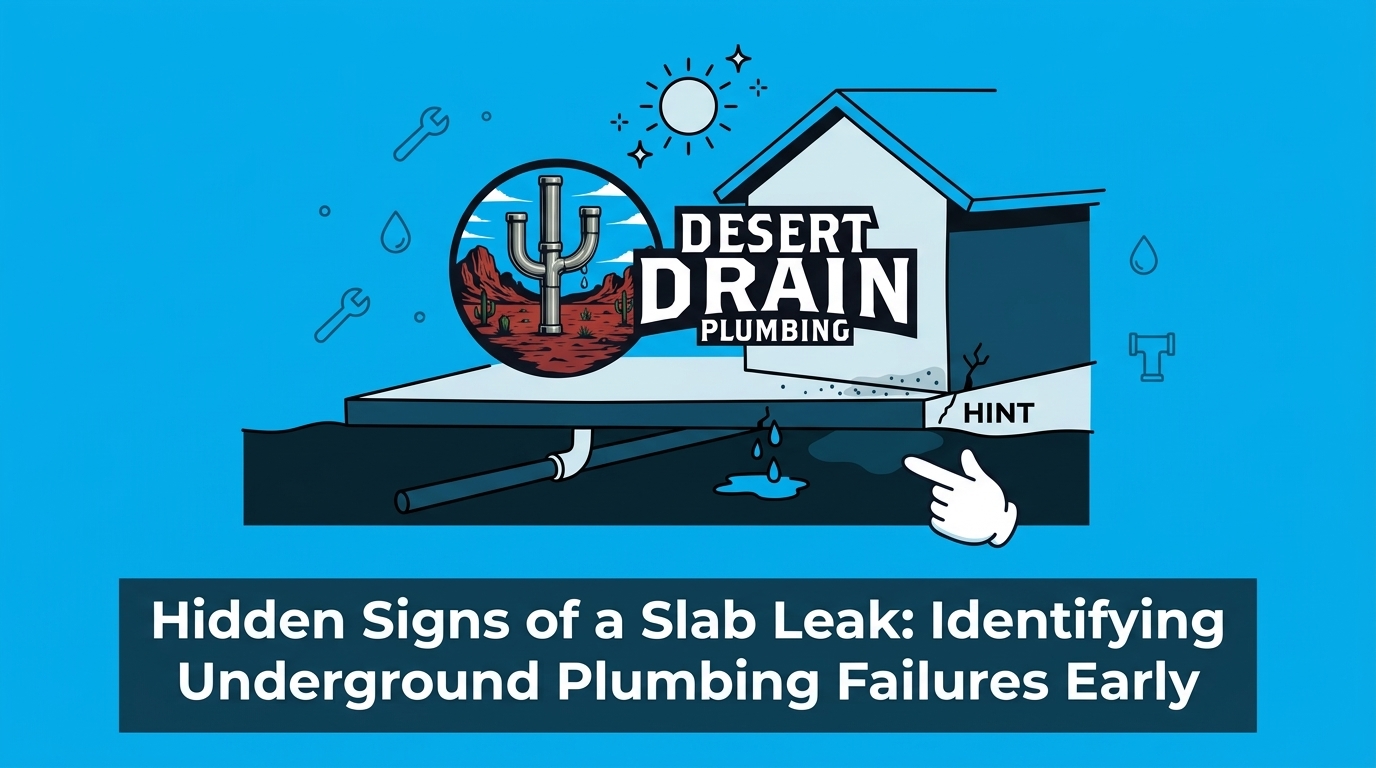
The Silent Threat Beneath Your Floors
Navigating home maintenance tips and troubleshooting can feel overwhelming, especially when the most destructive problems are buried beneath several inches of solid concrete. At Desert Drain Plumbing, our team has seen firsthand how a plumbing failure inside a wall often reveals itself quickly with a visible wet spot, but a leak beneath your home’s foundation is a completely different story. These hidden leaks can run for weeks or even months before showing obvious signs, quietly eroding the soil beneath your home and putting your entire foundation at risk.
For many homeowners, the sheer thought of an underground plumbing issue brings immediate anxiety. The fear of torn-up flooring, invasive repairs, and structural damage is entirely valid. However, the key to preventing catastrophic foundation damage lies in early detection. When you know exactly what subtle symptoms to look for, you can catch a failing pipe long before it causes a major structural emergency.
This is especially critical during seasonal transitions. As the intense summer heat gives way to cooler fall temperatures, the extremely dry soil around and beneath your foundation begins to contract and shift. This aggressive soil movement puts immense stress on aging pipes locked beneath the concrete slab. A pipe that survived the summer might suddenly develop a stress fracture or a pinhole leak as the ground settles in October. By learning to read the early warning signs your home gives you, you can stay one step ahead of these seasonal shifts and protect your property from the ground up.
Tracking the Financial Clue: Unexplained Water Bill Spikes
In our experience serving Mesa homeowners, the very first indicator of a hidden slab leak often does not happen inside your home at all—it happens in your mailbox or your email inbox. Sudden, unexplained increases in your monthly water consumption are a massive red flag. Because a pinhole leak under a slab flows continuously, 24 hours a day, it causes a steady and relentless increase in your overall water usage. Even a leak the size of a ballpoint pen tip can waste thousands of gallons of water over a single billing cycle.
The challenge is differentiating a genuine baseline usage spike from normal seasonal changes. For example, during the fall transition, many homeowners increase their irrigation schedules to overseed their lawns or establish winter grass. If your water consumption jumps, you need to verify whether the extra water is going to your landscaping or disappearing into the soil beneath your living room.
The Municipal Meter Test: You can confirm an active, continuous leak by performing a simple test using your home’s municipal water meter. We always recommend our customers follow these specific steps to isolate the issue:
- Shut off all water sources: Ensure every faucet, shower, dishwasher, washing machine, and automated irrigation system is completely turned off. Do not flush any toilets during this test.
- Locate your water meter: This is typically found in a concrete box near the street or sidewalk at the front of your property.
- Check the low-flow indicator: Most modern meters have a small triangular dial, a silver wheel, or a digital flow rate screen. If this indicator is spinning or registering flow while all water is shut off, water is actively escaping the system.
- Wait and verify: If your meter lacks a low-flow indicator, write down the exact numbers on the dial. Wait at least two hours without using any water in the house, then check the numbers again. If the reading has increased, you have a confirmed leak.
If you perform this test and the meter shows continuous flow, a pressurized pipe is leaking. If there are no visible drips inside the house or in the yard, that water is likely escaping beneath your concrete foundation.
Listening for Trouble: Phantom Water Sounds in Quiet Homes
Your ears can be just as effective as your water meter when it comes to early detection. Water escaping from a pressurized copper line creates distinct auditory clues, but these sounds are often masked by the daily hustle and bustle of a busy household. To catch these auditory signs, you need to listen to your house when it is entirely quiet.
When a pipe bursts or develops a pinhole leak beneath a concrete slab, the physical properties of the foundation actually work against you. Concrete is dense and acts as an acoustic transmitter, carrying the vibration of the escaping water up into the framing of your home. Our customers frequently describe hearing the faint sound of running water, hissing, or rushing when no appliances or faucets are actively running.
Key auditory clues to listen for:
- A constant, low hissing sound: This usually indicates water escaping through a tiny pinhole under high pressure. The sound often travels up through nearby walls.
- A rushing or trickling noise: This sounds similar to a toilet that hasn’t stopped running, but the noise seems to originate from the floorboards or the center of a room rather than a bathroom.
- The sound of a water heater constantly filling: If your water heater sounds like it is perpetually heating and filling, even when no one has taken a shower, a hot water line beneath the slab may be compromised.
The best time to check for these phantom sounds is during the quietest parts of the night, typically between 1:00 AM and 3:00 AM. Walk through your home, particularly in areas near the kitchen, bathrooms, and laundry room. Stop and listen closely to the floors and the lower sections of the walls. It is important to note that these auditory clues almost always indicate a pressurized supply line leak. A crack in a non-pressurized drainage pipe under the slab will rarely make a continuous sound, as water only flows through those pipes when a fixture is actively draining.
Feeling the Heat: Why Warm Spots Indicate Hot Water Line Leaks
We often receive calls about one of the most surprising and definitive signs of an underground plumbing failure: a physical change in the temperature of your flooring. If a hot water supply line develops a leak beneath your foundation, the thermodynamics of the situation will eventually reveal the problem right under your feet.
The Problem: You are walking barefoot through your kitchen or living room and suddenly notice a distinct, unusually warm patch of flooring. This spot remains warm regardless of the time of day or the ambient temperature of the house.
The Cause: When a hot water pipe running beneath the slab develops a leak, the escaping water pools in the soil and gravel directly under the concrete. Concrete is an excellent thermal conductor. The heat from the pooling water transfers directly upward through the slab, warming the adhesive, the underlayment, and finally the surface flooring itself. Because hot water lines are constantly pressurized, the leak continuously feeds fresh, hot water into the soil, keeping the spot permanently warm.
The Solution: Do not ignore localized warm spots. Often, family pets are the first to discover them, choosing to sleep in unusual places in the middle of a hallway or kitchen just to soak up the radiant heat. If you find a warm spot, immediately check your water meter and your water heater’s activity level.
It is helpful to understand how hot water line failures differ from cold water line failures, as they present very differently inside the home.
| Symptom Category | Hot Water Slab Leak | Cold Water Slab Leak |
|---|---|---|
| Temperature Changes | Distinct warm spots on tile, hardwood, or carpet. | No temperature change; floors remain cool to the touch. |
| Water Heater Activity | Water heater runs constantly to replace escaping hot water. | Water heater operates normally, only running after use. |
| Auditory Signs | Hissing sounds, plus the sound of the water heater running. | Hissing or rushing sounds from the floor or walls. |
| Energy Bills | Spikes in both water bills and gas/electric heating bills. | Spikes in water bills only. |
Spotting Structural Changes: Damp Flooring and Foundation Cracks
If a slab leak goes undetected through the early stages of water bill spikes and phantom sounds, it will eventually cause physical, visible damage to the structure of your home. When water continuously pools beneath the foundation, hydrostatic pressure forces that moisture upward through the porous concrete. This relentless moisture intrusion wreaks havoc on your interior finishes.
One of the first structural signs is compromised flooring. The moisture breaks down the chemical bonds in flooring adhesives. If you have tile, you might notice that certain tiles sound hollow when you tap them, or they may begin to heave and crack at the grout lines. Laminate and engineered hardwood floors will begin to warp, cup at the edges, or buckle entirely as the planks absorb the rising dampness. In carpeted rooms, capillary action draws the moisture straight up through the concrete and the carpet pad, leading to unexplained damp spots that never seem to dry.
Beyond the flooring, severe and prolonged leaks cause a process called undermining. As pressurized water sprays into the dirt beneath your home, it literally washes away the supporting soil. This leaves sections of your heavy concrete foundation suspended over empty voids. Eventually, the weight of the house causes the unsupported concrete to crack and settle. If you notice new, jagged cracks running across your foundation, or if doors and windows suddenly begin sticking in their frames, the leak has likely been active for weeks or months, and the structural integrity of the home is under threat.
The Danger of Mold and Mildew
Long before you see a crack in the foundation, trapped moisture creates another serious issue: aggressive biological growth. The dark, warm, and damp environment beneath your flooring is the perfect incubator for mold and mildew. A persistent musty smell in a specific room or hallway is often noticeable well before any visible mold appears on the baseboards. If your home suddenly smells like a damp basement, even though you live in a dry climate, moisture is likely intruding from below.

The Desert Effect: How Hard Water and Dry Soil Trigger Leaks
Understanding why these leaks happen requires looking at the specific environmental factors at play in the region. Underground plumbing does not exist in a vacuum; it is constantly interacting with the local soil and the municipal water supply. In the desert, these factors combine to create a uniquely hostile environment for buried copper pipes.
First, consider the water itself. As local Mesa plumbers, we know that the municipal water in our area is classified as “very hard” according to USGS data, meaning it contains exceptionally high levels of dissolved calcium and magnesium. As this hard water flows through copper pipes, these minerals precipitate out and cling to the interior walls of the plumbing, creating scale buildup. This scale does not build up evenly. It creates jagged, uneven surfaces inside the pipe that disrupt the smooth flow of water. The resulting turbulence causes the water to aggressively scrub the inside of the copper line, eventually wearing it thin from the inside out and creating microscopic pinhole leaks—a pattern we see almost daily.
Combine this internal wear and tear with extreme external pressures. The seasonal transition from brutal summer heat to cooler fall weather causes the extremely dry, expansive soils in the desert to contract and shift aggressively. As the ground settles, it pulls, pushes, and bends the weakened copper pipes trapped in the concrete. The combination of internal hard water corrosion and external soil shifting is the primary catalyst for underground failures. For a deeper dive into how these environmental factors break down plumbing systems, you can explore the science of slab leak repair to understand exactly what happens beneath the concrete.
Pinpointing the Problem: The Role of Non-Destructive Acoustic Detection
The Problem: Many homeowners notice the signs of a slab leak—a warm floor, a hissing sound, or a high water meter reading—but hesitate to call for help. The overwhelming fear is that a plumber will arrive and immediately start jackhammering the living room floor in a blind search for the broken pipe, causing massive property destruction in the process.
The Cause: Decades ago, finding an underground leak often did require destructive exploratory digging. Plumbers had to follow the moisture by breaking up concrete until they found the source, which was messy, expensive, and incredibly disruptive to the household.
The Solution: Today, noticing the signs of a slab leak is merely the first step in a high-tech, completely non-destructive diagnostic process. Our diagnostic team at Desert Drain Plumbing relies on modern acoustic leak detection technology that has revolutionized how these problems are found. Highly sensitive listening devices, ground microphones, and thermal imaging cameras allow our technicians to “see” and “hear” through the concrete. By amplifying the sound of the escaping water and tracking thermal anomalies, professionals can pinpoint the exact location of the failure down to a single square foot.
This non-destructive approach preserves your property and saves an immense amount of time. Instead of tearing up a whole room, the repair can be targeted, minimally invasive, and carefully planned. Knowing that the diagnostic process is safe and non-destructive should give you the confidence to act immediately when you spot early warning signs, rather than waiting in fear while the water continues to erode your foundation.
Frequently Asked Questions About Identifying Slab Leaks
What is the first sign of a slab leak?
In our experience, the very first sign is almost always an unexplained spike in your monthly water consumption. Because the leak is hidden underground, you will likely see the continuous flow reflected on your municipal water meter long before you notice damp floors or hear hissing sounds inside the house. Monitoring your water meter during periods of zero usage is the best way to catch the problem early.
Can a slab leak go undetected?
Yes, a slab leak can easily go undetected for months if the signs are subtle. If the leak is small and the escaping water drains deep into porous soil rather than pushing up through the concrete, you may not see any immediate physical damage. This is why paying close attention to your water usage and listening to your home when it is quiet is so important.
What does a slab leak sound like?
A slab leak typically sounds like a low hissing, rushing, or trickling noise coming from beneath the floorboards or echoing through the lower walls. It sounds very similar to a toilet that is continuously running or a faucet that hasn’t been completely turned off. Because concrete transmits sound well, the noise can sometimes be heard several feet away from the actual leak location.
How long does it take for a slab leak to cause damage?
The timeline varies depending on the size of the leak and the type of soil beneath your home, but structural damage can begin occurring within a matter of weeks. As water washes away the supporting dirt, the foundation becomes undermined and can crack under the weight of the house. Cosmetic damage to flooring and baseboards usually appears within a few weeks of the moisture reaching the surface.
Do warm spots on the floor always indicate a hot water slab leak?
While a distinct, permanent warm spot on a hard surface floor is a classic indicator of a hot water line leak, it is not the only possibility. Uninsulated hot water pipes running too close to the surface of the concrete can sometimes radiate heat during heavy use. However, if the spot remains warm around the clock and your water heater is running constantly, an underground leak is highly probable.
How does hard water contribute to under-slab pipe leaks?
Hard water contains high levels of dissolved minerals like calcium and magnesium, which stick to the inside of copper pipes and create scale buildup. This rough scale causes the water to flow turbulently rather than smoothly. The turbulent water slowly scrubs the inside of the copper pipe, eventually wearing it thin and causing pinhole leaks to develop from the inside out.
Protecting Your Home’s Foundation Before Damage Spreads
Recognizing the early warning signs of a hidden underground plumbing failure is the most effective way to protect your home from devastating structural damage. Whether it is a phantom hissing sound in the middle of the night, a sudden spike in your water consumption, or an inexplicably warm spot on your kitchen floor, these clues should never be ignored. Catching the problem early means the difference between a targeted repair and a major foundation overhaul.
Remember that prompt action does not mean immediate destruction. Modern, non-destructive acoustic detection allows experts to locate the exact source of the problem without unnecessarily tearing up your property. If you have noticed any of these subtle symptoms in your home, especially during the shifting temperatures of the fall season, reach out to the experts at Desert Drain Plumbing to have your foundation safely and accurately tested.