

The Endless Hot Water Myth: Why Efficiency Demands Commitment
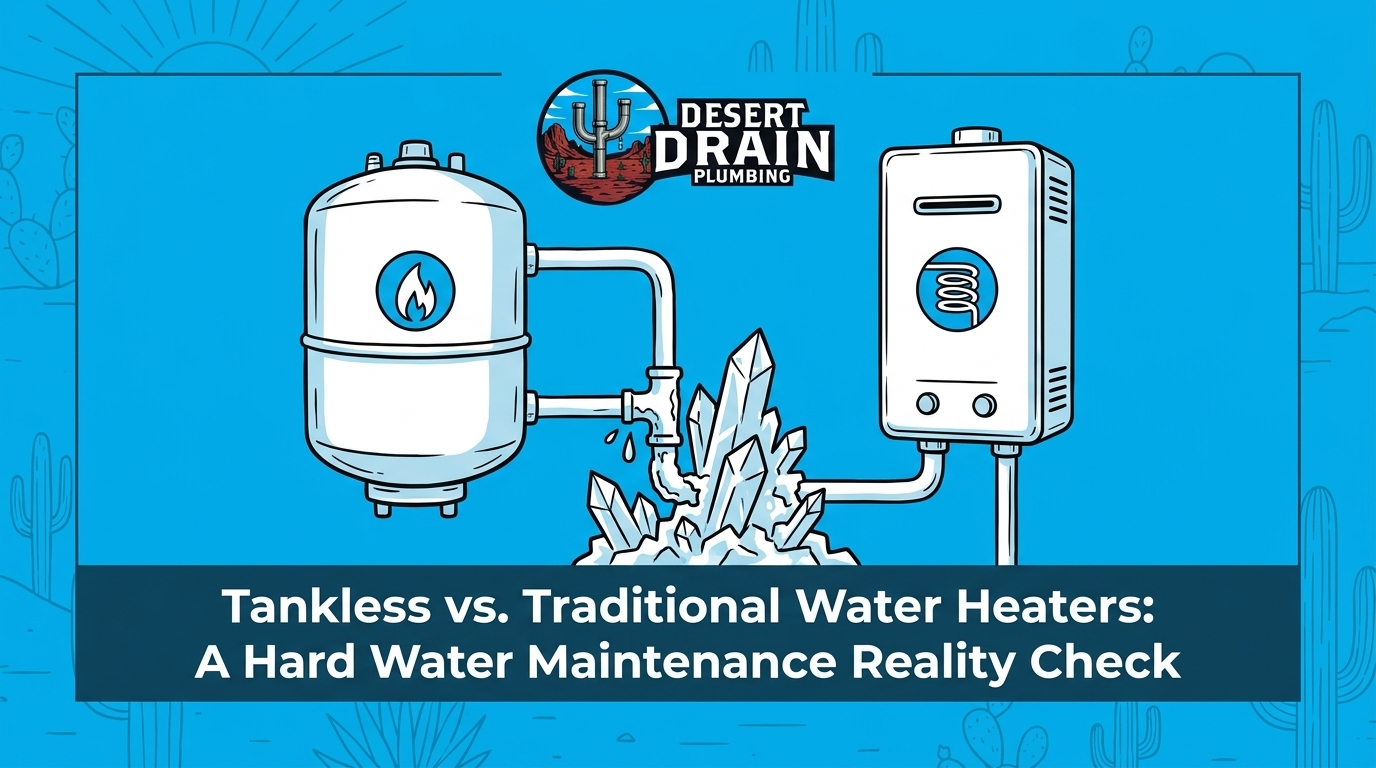
If you are researching the topic of Tankless vs. Traditional Water Heaters: A Hard Water Maintenance Reality Check, you might believe a very common myth: that upgrading to a modern, high-efficiency system automatically eliminates your household plumbing headaches. The prevailing assumption is that once a new unit is mounted on the wall or set in the garage, you can simply enjoy endless hot showers and lower utility bills without a second thought. Here is the reality: high energy efficiency demands an equally high commitment to maintenance.
This disconnect between theoretical efficiency and actual upkeep becomes painfully obvious during the late-summer back-to-school transition. Our team at Desert Drain Plumbing sees this pattern every August: as multiple family members suddenly need hot showers at 6:30 a.m., a neglected water heater quickly reveals its weaknesses. The core problem you face is balancing your desire for energy efficiency against the harsh realities of local water chemistry. Hard water does not care about the energy rating on the box.
At Desert Drain Plumbing, we believe in providing honest, localized advice rather than simply pushing the newest technology. We want to ensure you are never blindsided by hidden maintenance obligations. This guide serves as an honest decision framework to help you choose the right system based on your actual tolerance for routine upkeep, rather than just the promise of endless hot water.
How Narrow Heat Exchangers React to Mineral-Heavy Water
To understand why maintenance is so critical, you have to look inside the equipment. Tankless systems operate using highly engineered, compact heat exchangers. These components feature extremely narrow pathways designed to transfer intense heat to the water as it rapidly flows through the unit. While this design is a marvel of modern engineering, it is highly vulnerable to local water conditions.
In our years of servicing Mesa homes, we have pulled apart countless heat exchangers choked by our municipal water supply, which often exceeds 15 grains per gallon of hardness—classifying it as extremely hard. This severe concentration of dissolved minerals changes everything. As water heats up inside those narrow pathways, a chemical reaction occurs. The rapid temperature increase causes calcium and magnesium to precipitate out of the water much faster than they would at lower temperatures. These minerals immediately cling to the internal walls of the heat exchanger, creating what plumbers refer to as high mineral and scale buildup.
The cascading failure process:
- Initial accumulation: Microscopic layers of calcium carbonate coat the copper or stainless steel pathways.
- Thermal insulation: Scale acts as a highly effective insulator. The heat from the burner can no longer transfer efficiently into the water.
- Overheating: The system’s sensors detect that the water is not reaching the target temperature, forcing the burner to fire hotter and run longer.
- Component stress: The extreme, trapped heat eventually weakens the metal, leading to internal stress fractures and complete system failure if professional intervention is ignored.
The Efficiency Drop-Off
The irony of a neglected tankless system is that scale buildup forces the unit to work so hard that it negates the very energy savings you originally purchased it for. Instead of a highly efficient appliance, you end up with an overworked unit burning excess fuel just to push heat through a thick wall of calcium.
Furthermore, the restricted flow pathways trigger internal safety mechanisms. You will start seeing error codes flashing on the digital display, followed by sudden, frustrating shut-offs right in the middle of high-demand moments. Standard manufacturer timelines often suggest maintenance every couple of years, but in our local extreme hard water environments, those generic suggestions are dangerously inadequate.
Sacrificial Anode Rods: The Traditional Tank’s First Line of Defense
To make an informed choice, you need to contrast the vulnerabilities of a tankless unit with how traditional tank water heaters handle hard water mechanically. A traditional tank does not rely on narrow, precision pathways. Instead, it uses a large steel basin to hold and heat water. However, steel and water naturally lead to rust, which is why traditional tanks rely on a critical component: the sacrificial anode rod.
The sacrificial anode rod is a long metal rod, usually made of magnesium or aluminum, suspended inside the tank. Its sole purpose is to undergo galvanic corrosion. Because the metals in the rod are more reactive than the steel lining of the tank, the corrosive elements and dissolved minerals in the water attack the rod instead of the tank walls. The rod literally sacrifices itself to protect your investment.
While the large basin of a traditional tank is less susceptible to the immediate flow restrictions that plague tankless heat exchangers, it is not immune to hard water. As the hard water is heated, calcium and magnesium still precipitate out, but instead of clogging a narrow tube, they fall to the bottom of the tank as sediment. Over time, this high mineral and scale buildup forms a thick, hardened layer over the gas burner or lower heating element.
Our plumbers typically see factory anode rods eaten away in just 18 to 24 months here in Mesa AZ, far faster than national averages suggest due to the extreme water hardness. Traditional tanks still require annual flushing to remove that bottom sediment layer, and the anode rod must be inspected and replaced periodically. The mechanical failure points are different than the precision pathways of a tankless unit, but the need for proactive defense remains absolute.
The Fine Print: Why Warranties Mandate Professional Descaling
Many homeowners assume that if their new, expensive water heater fails within the first ten years, the manufacturer’s warranty will cover the replacement. This is a dangerous assumption in hard water zones. When you read the fine print of high-efficiency tankless warranties, you will find strict clauses that require proof of regular, professional descaling.
A pattern we see often is frustrated homeowners calling us with a denied warranty claim because damage caused by high mineral and scale buildup is almost universally excluded from manufacturer defect coverage. Manufacturers argue—correctly—that scale accumulation is a local environmental issue, not a defect in their factory materials or workmanship. If a heat exchanger cracks because it was choked with calcium, the replacement cost falls entirely on the homeowner.
Here is why manufacturers mandate professional service rather than a DIY approach:
- Chemical Complexity: A standard flush with water does absolutely nothing to remove hardened scale. Professional descaling requires a specific, food-grade acidic solution designed to dissolve calcium without eating away at the internal copper or stainless steel components.
- Specialized Equipment: The process requires isolating the unit from your home’s plumbing and using a specialized submersible pump to circulate the chemical solution through the heat exchanger for 45 to 60 minutes.
- Flow Rate Verification: After the chemical flush, a professional must neutralize the system, clean the internal inline filters, and verify that the flow rate and gas pressure have returned to factory specifications.
- Safety Protocols: Working with gas lines, high-voltage electrical components, and pressurized hot water requires a licensed professional to ensure the home remains safe and up to code.
Descaling is a complex maintenance procedure, not a weekend DIY project. If you cannot produce service records from a licensed plumber proving this was done annually, your warranty claim for a failed heat exchanger will likely be denied.
Side-by-Side: Evaluating the Realities of Water Heater Upkeep
When evaluating which system belongs in your home, it helps to look at the maintenance requirements side-by-side. Both systems will fail prematurely if neglected in Mesa AZ, but the way they fail—and the effort required to keep them running—differs significantly. Frame your comparison purely around your maintenance tolerance rather than the upfront installation costs.
| Maintenance Factor | Tankless Water Heaters | Traditional Tank Heaters |
|---|---|---|
| Annual Maintenance Requirement | Professional chemical descaling and filter cleaning to clear narrow pathways. | Standard tank flushing to remove loose sediment and pressure valve testing. |
| Component Replacement | Rare, assuming annual descaling is strictly followed to prevent heat exchanger damage. | Sacrificial anode rod replacement every 2-3 years in severe hard water. |
| Consequences of Neglect | Immediate flow restriction, error codes, sudden shut-offs, and cracked heat exchangers. | Slow efficiency loss, reduced hot water capacity, popping noises, and eventual tank rupture. |
| Space and Capacity Impact | Wall-mounted, endless supply remains constant only if pathways are perfectly clear of scale. | Large footprint, limited capacity that shrinks further as sediment displaces water volume. |
| Warranty Vulnerability | Strictly excludes scale damage; requires documented professional descaling records. | Excludes scale damage; requires proof of routine flushing and anode rod upkeep. |

Matching Your Household Routine to the Right System
Ultimately, the best water heater for your home is the one that aligns with your actual lifestyle, household demand, and willingness to schedule routine maintenance. It is time to assess your daily routines honestly.
Consider the late-summer back-to-school transition. If you have three teenagers who all need to shower between 6:00 a.m. and 7:00 a.m., a traditional 40-gallon tank will run out of hot water quickly. In this scenario, the endless supply of a tankless system is highly appealing. However, if endless hot water and space savings are paramount to your family, you must be fully committed to scheduling an annual professional descaling. If you know you are the type of homeowner who sets a calendar reminder and follows through, a tankless unit will serve you beautifully. We frequently recommend these systems to homeowners looking to take advantage of generic local utility rebate programs for high-efficiency upgrades, provided they understand the upkeep involved.
On the other hand, if you prefer a more hands-off approach to home maintenance and know that you are likely to skip annual service appointments, a traditional tank may be the safer long-term investment. While a neglected traditional tank will eventually fail, it usually fails slower than a neglected tankless unit. The large basin can tolerate a certain amount of sediment buildup before it completely stops producing hot water, whereas a tankless unit will simply shut down when flow is restricted.
You should also factor in how seasonal temperature shifts and hard water interact to affect your overall water comfort. For instance, understanding why your tap water temperatures fluctuate during Arizona summers can help you realize that your water heater works differently depending on the season. During the hottest months, the incoming ground water is already warm, meaning your system works less to reach the target temperature. But as the seasons change and incoming water cools, a scale-choked heat exchanger will struggle to bridge that larger temperature gap, leaving you with lukewarm showers just when you need hot water the most.
Answers to Common Questions About Hard Water and Water Heaters
Are tankless water heaters bad for hard water?
The short answer is no, but they require strict, non-negotiable maintenance to survive it. Tankless systems are highly efficient, but their narrow internal pathways are easily choked by calcium. As long as you commit to annual professional descaling, a tankless unit will perform exceptionally well even in severe hard water conditions.
How often do you need to flush a water heater in this region?
You need to service your water heater annually due to the extreme hardness of the local water supply. For a traditional tank, this means a full drain and flush to remove bottom sediment. For a tankless system, this means a 45-minute chemical circulation flush to dissolve high mineral and scale buildup inside the heat exchanger.
What happens if you don’t descale a tankless water heater?
If you skip descaling, your system’s efficiency plummets rapidly. The calcium buildup acts as an insulator, forcing the unit to burn hotter to heat the water. Eventually, this restricted flow will trigger error codes, cause sudden shut-offs, crack the heat exchanger, and completely void your manufacturer’s warranty.
How does hard water affect a traditional water heater?
Hard water causes dissolved minerals to fall to the bottom of the traditional tank as sediment. Over time, this thick layer of sediment buries the lower heating element or insulates the water from the gas burner, forcing the tank to run longer. It also causes the sacrificial anode rod to deplete much faster, leaving the steel tank vulnerable to rust and eventual rupture.
Can a water softener protect my tankless heater?
Yes, installing a whole-home water softener significantly reduces the amount of scale that enters your water heater. By removing the calcium and magnesium before it reaches the heat exchanger, the softener protects the narrow pathways. However, annual inspections and occasional flushes are still recommended to ensure optimal performance and maintain warranty compliance.
Make an Informed Upgrade for Your Home’s Water Quality
The decision between a tankless and traditional water heater should never be based solely on the promise of lower utility bills. The best water heater is simply the one you are willing to properly maintain. Local water chemistry dictates the lifespan of any system you choose, and in our experience serving Mesa AZ, ignoring that chemistry will lead to premature failure regardless of the brand you buy.
At Desert Drain Plumbing, we prioritize transparent advice over pushing unnecessary upgrades. We want you to enjoy reliable hot water without the stress of unexpected breakdowns or voided warranties. If you are unsure which system aligns with your household demands and maintenance habits, reach out to us today. Schedule a professional evaluation, and we will help you make a choice that keeps your home comfortable and your plumbing protected year-round.