

Are You Treating the Root Cause or Just Buying Time?
Are you tired of paying for a main line clearing, only to watch the drains start gurgling again a few months later? When you are constantly battling stubborn sewer blockages, understanding the difference between Hydro-Jetting vs. Traditional Snaking for Palo Verde Root Invasions is the first step toward a permanent solution. That strange bubbling sound from your toilet or the slow drain in your shower usually means something sinister is growing underground.
At Desert Drain Plumbing, we frequently see homeowners trapped in a frustrating cycle. You notice a backup, call a professional to run a cable down the line, and enjoy a brief period of normal plumbing. But the relief never lasts. The core issue is that highly aggressive native tree roots are infiltrating vulnerable underground infrastructure. Older terracotta and cast-iron sewer lines are particularly susceptible to these biological invasions.
This leaves you facing a critical decision point. Do you continue relying on traditional snaking, which acts as a temporary bandage, or do you invest in hydro-jetting, a comprehensive scouring method? To break the cycle of recurring backups, you need to understand exactly how these two distinct methods interact with the dense root masses choking your plumbing.
The Palo Verde Threat: Why Desert Roots Target Vulnerable Pipes
To understand why your sewer line keeps backing up, we always advise our customers to look at the environment around their home. In an arid desert climate, native roots are vastly more aggressive in seeking moisture than in temperate zones. Trees like the Palo Verde are incredibly drought-resistant, but they survive by relentlessly driving their root systems toward any available subterranean water source. Your sewer line is essentially an underground oasis.
Our technicians typically see this problem peak during the early fall transition when dry-season root moisture-seeking is at its highest. After a long, scorching summer, the soil is completely parched. The trees are desperate for hydration. They sense the moisture vapor escaping from your plumbing and direct their growth precisely toward that microscopic water source. Once they find it, they do not let go.
Older plumbing systems are highly vulnerable to this aggressive behavior. Decades-old pipes were not designed to withstand the relentless pressure of drought-stressed desert landscaping.
The Porous Nature of Aging Infrastructure
The specific materials used in older Mesa homes present a unique challenge that our plumbers navigate daily. Terracotta (clay) pipes and aging cast iron have inherent weaknesses that roots easily exploit.
- Microscopic leaks: Aging pipes often have bell-and-spigot joints sealed with mortar or older materials that degrade over time, allowing moisture vapor to escape into the surrounding soil.
- Porous surfaces: Terracotta is naturally porous. As it ages, it can absorb and sweat small amounts of water, creating a beacon for thirsty roots.
- Brittle degradation: Cast iron rusts and scales from the inside out, creating uneven surfaces and tiny fissures that hair-like roots can penetrate.
Once a single, microscopic root hair breaches the pipe joint, the real damage begins. The root finds a constant supply of water, oxygen, and nutrients inside the sewer line. This causes the fibrous root mass to explode in growth, rapidly expanding inside the pipe until it forms a dense, impenetrable net that catches toilet paper, grease, and waste.
The Mechanics of Traditional Snaking: A Temporary Puncture
For decades, the standard response to a blocked drain has been the traditional plumbing snake, also known as a mechanical auger. While this tool is excellent for clearing soft clogs like hair or paper, it is severely limited when dealing with aggressive biological growth. Traditional snaking is an incomplete solution for severe root intrusions.
The process relies on physical, mechanical force to break through a blockage. Here is exactly how traditional snaking interacts with a root-infested pipe when a technician performs the service:
- Insertion and navigation: A technician feeds a flexible metal cable tipped with a cutting blade down your sewer cleanout.
- Mechanical rotation: A motor spins the cable, causing the cutting head to rotate rapidly as it pushes forward.
- The initial breach: When the blade hits the dense Palo Verde root mass, it chops and tears through the center of the obstruction.
- Restoring flow: The blade pushes through to the other side, allowing trapped wastewater to finally drain away.
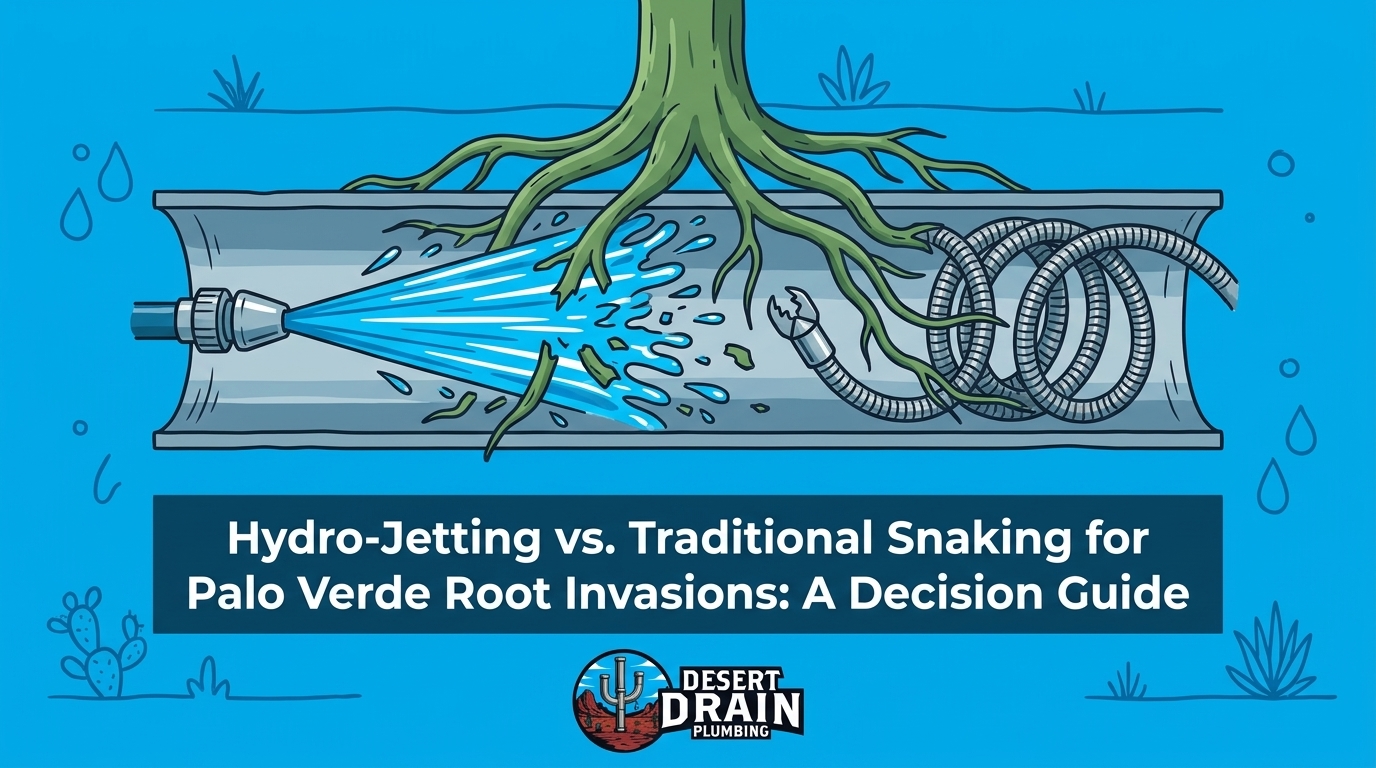
The critical flaw lies in the physical size of the cutting head. A standard auger blade is smaller than the diameter of the pipe. When it hits a massive root intrusion, it merely punches a hole straight through the center of the mass. It leaves the entire perimeter of the root structure completely intact and clinging to the pipe walls.
If you leave root fragments behind, you guarantee rapid regrowth. This is especially true in arid environments where the tree is already desperate for water. The freshly cut roots respond by growing back thicker and faster than before. In our years of servicing historic Mesa neighborhoods, we constantly hear from homeowners who find that snaking only buys them a few weeks or months of relief before the exact same backup occurs. It is a temporary bandage, not a permanent clearing method.
Hydro-Jetting: Scouring the Pipe Walls Clean
This is why our team at Desert Drain Plumbing highly recommends hydro-jetting. If snaking only punches a hole, hydro-jetting completely resets the environment inside the pipe. This method is mechanically superior for handling dense, recurring biological blockages because it removes the entire root mass rather than just piercing it.
Hydro-jetting utilizes a specialized hose equipped with a multi-directional nozzle. Connected to a high-powered machine, this tool blasts water at highly calibrated pressures. A forward-facing jet breaks up the initial blockage, while powerful rear-facing jets scour the entire inner diameter of the pipe wall and propel the hose forward. You can learn more about the science of clearing severe pipe blockages to see exactly how this fluid dynamics approach breaks down stubborn debris.
The total clearing advantage:
Unlike a spinning blade that leaves the outer ring of roots attached, hydro-jetting uses the force of water to peel the fibrous root fragments right off the pipe walls. It flushes the entire mass down the municipal sewer line. By completely scouring the pipe wall, you eliminate the immediate root structure. While roots may eventually try to return, starting from zero significantly slows down the regrowth process compared to a partially cleared pipe.
The requirement for visual confirmation:
Because hydro-jetting is so thorough, we always pair it with a video camera inspection. One of our technicians will run a specialized camera down the line before the process begins to assess the blockage, and again after the process is complete to verify that the pipe walls are entirely free of root fragments. This ensures that older terracotta and cast-iron sewer lines are completely clear and structurally intact.
Side-by-Side Comparison: Snaking vs. Hydro-Jetting for Root Intrusions
Making the right choice for your home depends on understanding the fundamental differences between these two approaches. While both will get your drains flowing again today, their long-term impact on your plumbing is vastly different. When we consult with our clients, we use the table below to outline how each method handles aggressive root masses in historic Mesa neighborhoods.
| Feature | Traditional Snaking (Augering) | Hydro-Jetting |
|---|---|---|
| Effectiveness on Dense Roots | Punches a temporary hole through the center of the mass; leaves the perimeter intact. | Scours the entire inner diameter of the pipe; removes the root mass completely. |
| Longevity of the Fix | Short-term. Fibrous roots regrow rapidly, often requiring another clearing in weeks or months. | Long-term. Stripping the pipe walls bare significantly delays any potential root regrowth. |
| Impact on Pipe Walls | Uses rotating metal scraping blades that can sometimes catch on uneven, aging pipe joints. | Uses multi-directional water pressure to safely wash away debris without metal-on-metal scraping. |
| Ideal Use Case | Minor soft clogs (hair, paper) or retrieving foreign objects dropped down a drain. | Severe, recurring biological blockages, heavy grease buildup, and extensive root intrusions. |
The bottom line: If you are dealing with a one-time soft clog, a traditional snake is often all you need. But if you are fighting a losing battle against aggressive desert trees invading your main line, hydro-jetting is the only way to completely reset the pipe.

Addressing Safety Concerns: High-Pressure Water in Aging Infrastructure
It is completely normal to have reservations about hydro-jetting. The idea of blasting high-pressure water through decades-old plumbing sounds risky. Homeowners often worry that the intense force will shatter brittle pipes or blow out delicate joints.
This is a valid concern, but modern hydro-jetting is not a blunt-force instrument. It is a highly precise tool. Leveraging our specialized local knowledge of historic Mesa plumbing infrastructure allows our professionals to explain exactly how pressure is calibrated safely for porous terracotta and brittle cast iron. The equipment features adjustable pressure settings, allowing the technician to dial back the PSI to a level that obliterates roots without threatening the structural integrity of the older terracotta and cast-iron sewer lines.
The Role of Video Inspections
The secret to safe hydro-jetting lies in the preparation. At Desert Drain Plumbing, our qualified professionals will never jet a line blind. Seeing the pipe’s condition is a mandatory first step in the process.
- Assessing structural integrity: A high-definition camera is fed through the line to look for severe cracks, massive offsets, or sections where the pipe has already collapsed.
- Identifying the material: The camera confirms whether the line is clay, cast iron, or a newer synthetic material, which dictates the exact water pressure and nozzle type used.
- Preventing further damage: If the video inspection reveals that a pipe is severely compromised or actively collapsing, the technician will halt the jetting process. High-pressure water cannot fix a broken pipe, and a true professional will pivot to discussing repair or replacement options instead of risking further damage.
When performed by a trained expert who relies on camera data, hydro-jetting is entirely safe for aging infrastructure.
Frequently Asked Questions About Clearing Tree Roots
Why do tree roots keep coming back after snaking?
Tree roots return quickly after snaking because the mechanical blade only punches a hole through the center of the blockage. It leaves the fibrous root perimeter firmly attached to the pipe walls. Because the water source remains constant, these leftover root fragments regenerate rapidly, often growing back thicker and more aggressive than before.
Can hydro jetting damage old clay or cast iron pipes?
Hydro-jetting is safe for old clay and cast iron pipes when performed by a professional who properly calibrates the water pressure. The process always begins with a video camera inspection to verify the pipe’s structural integrity. If the line is already cracked, severely degraded, or collapsing, our professionals will not use high pressure and will recommend a repair instead.
How do you permanently get rid of tree roots in sewer lines?
The only truly permanent way to eliminate tree roots is to repair or replace the compromised section of the sewer line so roots can no longer enter. However, we find that hydro-jetting is the most effective maintenance method to completely scour the roots away and maximize the time between clearings. Pairing hydro-jetting with an EPA-approved root inhibitor can also significantly delay future growth.
Is hydro jetting better than snaking for tree roots?
Yes, hydro-jetting is vastly superior to snaking when dealing with heavy root intrusions. While a snake simply tears a temporary path through the center of the roots, hydro-jetting uses multi-directional water pressure to wash the entire inner diameter of the pipe clean. This comprehensive scouring removes the roots completely and flushes the debris out of your system.
Does the time of year affect root intrusion severity?
Yes, root intrusions often peak based on seasonal weather patterns. The early fall transition when dry-season root moisture-seeking peaks is a particularly common time for severe sewer backups. After a long, hot summer with minimal rainfall, drought-stressed trees become highly aggressive in their search for underground moisture, driving them directly into vulnerable plumbing joints.
Make the Right Choice for Your Sewer Line Today
Dealing with recurring sewer backups is stressful, unsanitary, and entirely preventable. Aggressive native roots require a comprehensive solution, not just a temporary bandage that leaves you waiting for the next disaster. Traditional snaking may offer a quick fix, but it leaves the core problem clinging to your pipe walls.
If you live in one of the historic Mesa neighborhoods and suspect Palo Verde roots have breached your line, it is time to stop guessing. A professional video camera inspection from our team will reveal the exact condition of your pipes and determine the safest, most effective clearing method for your specific infrastructure. Do not wait for another messy backup to disrupt your life. Schedule a camera inspection and consultation with Desert Drain Plumbing today to permanently address recurring blockages and restore your home’s plumbing to full capacity.